
Understand acknowledgement, backlog and recovery.
Use real receipts and set clear delivery boundaries.
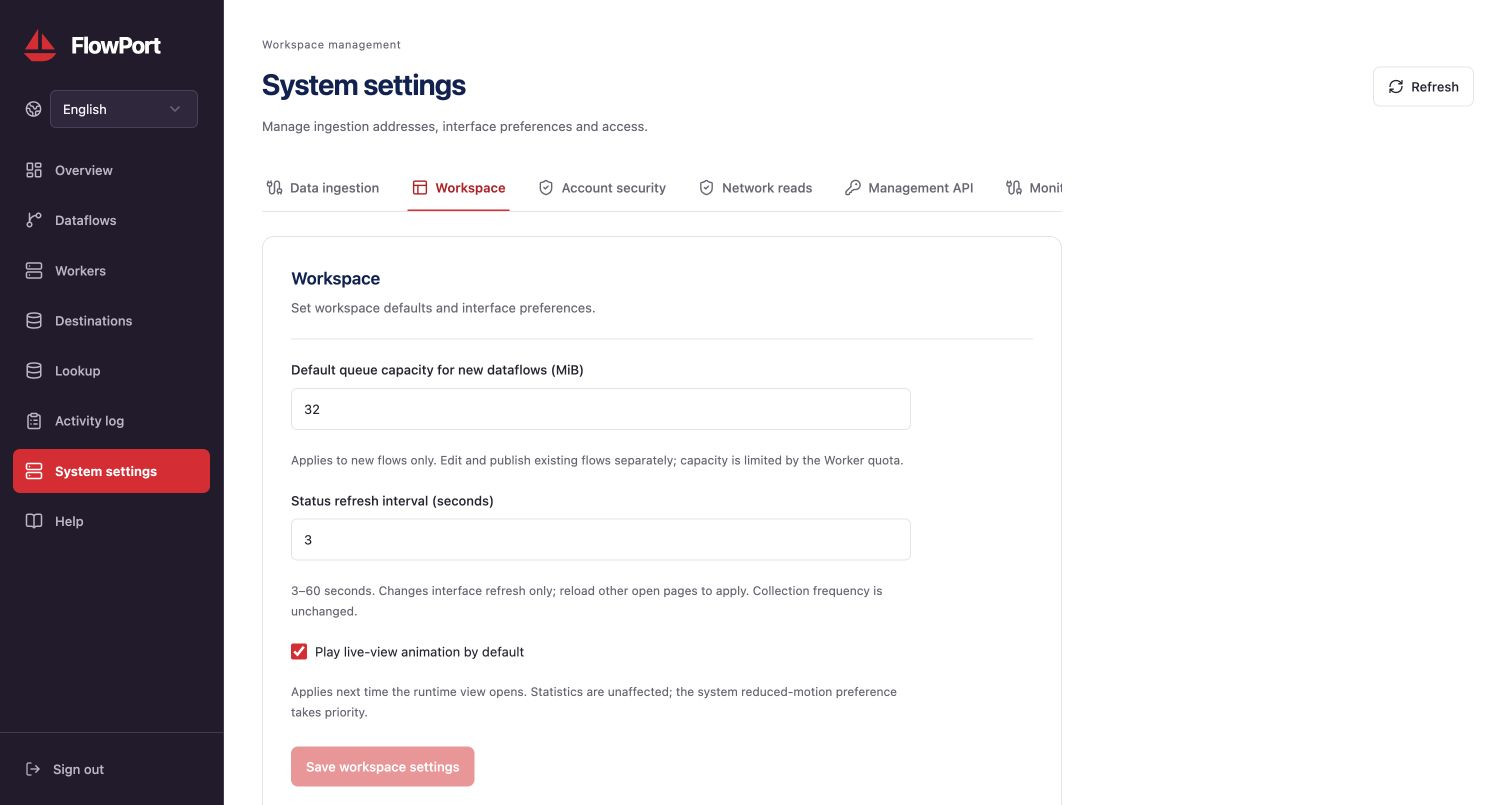
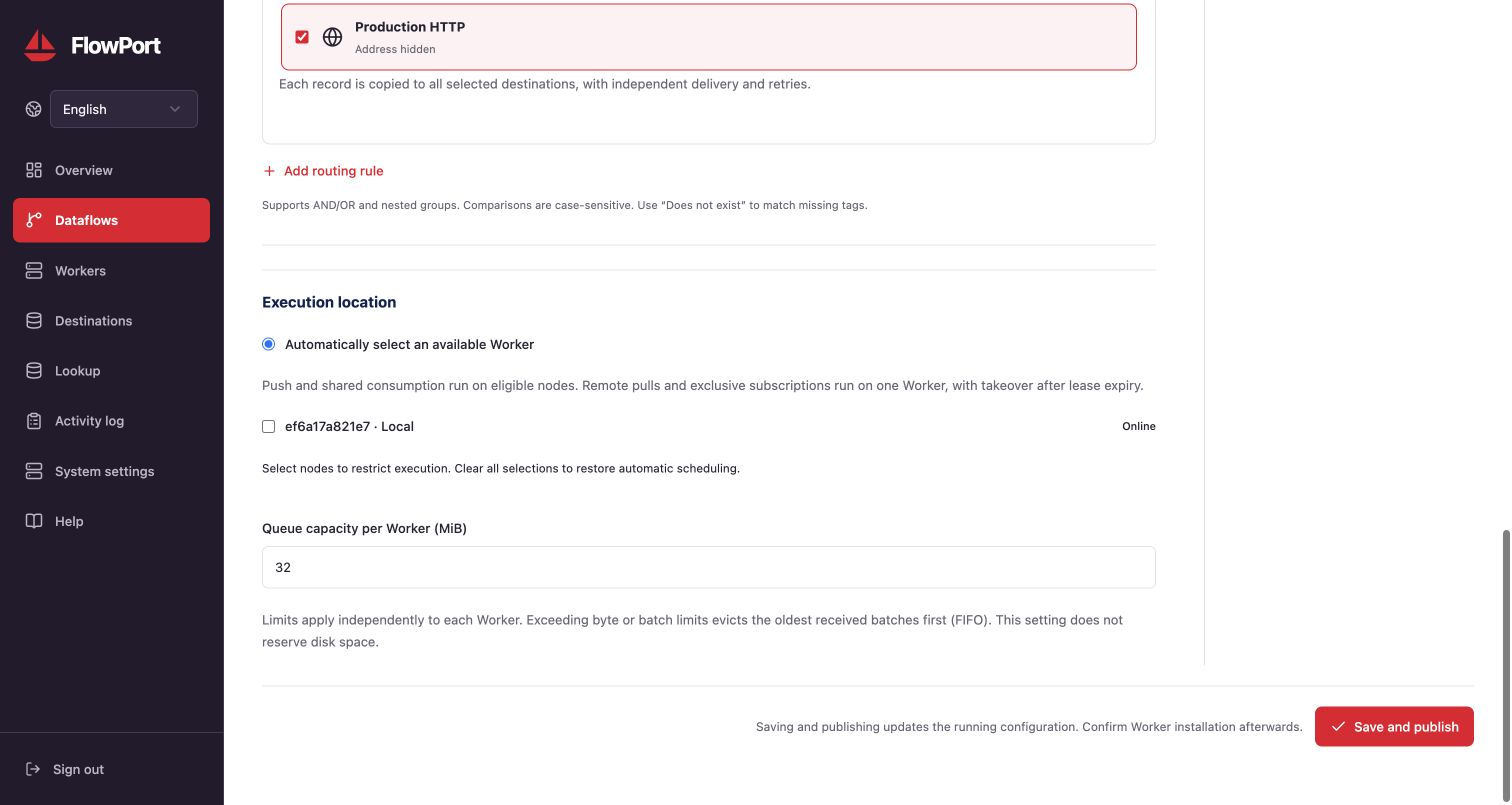
The website brand is now FlowPorts. These screenshots were captured on 2026-10-26 from the released 0.4.1 English interface, which still displays the original FlowPort name, in an isolated OrbStack instance with synthetic data. See the integration guide for the MaxCompute destination introduced in 0.5.13. Addresses and counters are examples; CDC and Dataway forms illustrate configuration without connecting to real services. Select an image for full size. The screenshot manifest records build provenance and file hashes.
Native durable queues
FlowPorts uses native durable storage without SQLite. Source acknowledgement confirms persistence on the current Worker. Worker queues are independent and are not automatically replicated.
Each Worker reserves separate input and destination quotas. A full output retains the whole input until space is available; a full input rejects new requests. Other queued outputs and flows can continue.
Each queue has a persisted UUID in its delivery identity, retained across restart and full backup restoration. Copies of one backup must not deliver concurrently. Destination deduplication depends on its protocol and window; strict exactly-once delivery is not guaranteed.
Logical quotas do not reserve physical disk. Reserve space for journals and reclamation.
Confirmation batches group receipts by flow and cursor, updating each page list once to reduce repeated parsing and writer-lock time under backlog. All branches still complete before ordered cursor advancement; deletes, counters and cursors share one synchronous durable transaction. Durability is unchanged.
Cursor-bearing intake rejects new input when its receipt metadata budget is exhausted. A receipt advances in order only when all related destination branches have terminated, including counted discards; this can leave a data gap.
FlowPort 0.5.5 retains acknowledged data when output queues are full or fast delivery retries are exhausted. Full outputs retain the entire input; full inputs reject new requests for upstream retry. After five fast retries by default, unconfirmed data continues with slow retries at least 60 seconds apart. Back up each node and coordinate manager and Worker upgrades to protocol v9. Previously discarded payloads cannot be recovered, and ambiguous receipts can still cause duplicates.
Lowering fast retries preserves queued records, partial receipts and existing backoff deadlines.
Acknowledgement and terminal failure
Elasticsearch/OpenSearch Bulk confirms individual records. Confirmed records are not resent; unconfirmed records remain queued for retry.
Downstream acknowledgement follows each protocol, such as HTTP success, Kafka ISR acknowledgement or an object write. There is no cross-destination transaction or absolute ordering.
A crash after remote acceptance but before local completion can duplicate data during normal queue recovery. Delivered points divided by input batches is not a success rate; runtime views separate input-processing and target-output failure rates.
MongoDB rejects w=0 and checks acknowledged writes. ClickHouse INSERT forces wait_end_of_query=1 and wait_for_async_insert=1; 2xx still requires no exception body or nonzero X-ClickHouse-Exception-Code. Rejected or incomplete confirmation retains the branch for local retry.
HTTP returns 503 with Retry-After for storage, admission or cancellation failures before durable acceptance. Invalid payloads remain 400 and invalid credentials remain 401.
Failure release and legacy migration
FlowPort 0.5.5 retains acknowledged data when output queues are full or fast delivery retries are exhausted. Full outputs retain the entire input; full inputs reject new requests for upstream retry. After five fast retries by default, unconfirmed data continues with slow retries at least 60 seconds apart. Back up each node and coordinate manager and Worker upgrades to protocol v9. Previously discarded payloads cannot be recovered, and ambiguous receipts can still cause duplicates.
Retry preserves the processed body, destination ID and delivery identity. Republish the same destination ID to use its newly published connection settings on the next attempt, without rerunning Pipeline or new routing. If the new publication removes that target, its queued branch retains its original connection. Counters remain attributed to the original input version. Editing a draft or saving a Destination alone does not update backlog.
Back up each node and coordinate all managers and Workers to protocol v9. Earlier isolated failed payloads require explicit offline migration.
Stopping a flow stops new ingestion while accepted data continues processing and delivery. Drain and confirm no backlog before removing nodes or data directories.
Redis 7+ recovery records missing pending IDs returned by XAUTOCLAIM in durable loss counters and fails that recovery attempt. Reconnect and restart retain the evidence without counting it twice. Redis 6.2 cannot report these IDs; deleted upstream data is not recovered.
Metrics and diagnostics
Processing failures, send attempts and historical capacity drops are counted separately. Full queues retain acknowledged input and apply backpressure.
Connection testing separates network reachability from protocol requests. Read-only checks cannot prove write permission. Sampling does not add consumers, acknowledge messages or advance cursors.
The observe API adds samples for relevant, nonremoved Workers: worker_id, process instance, installed version, sample_at (Unix milliseconds), online, healthy, per-flow stats and targets for the installed version. Offline reports retain historical totals, not live rates. targets=null means a missing report; a target absent from a reported array has no confirmed delivery in that version. worker scopes the samples to one node. Top-level sample_at cannot replace individual Worker clocks when calculating fleet rates.
Each Worker keeps at most 1000 diagnostic groups including Other, 3 recent samples per group, 1 KiB per sample and 8 MiB total. Only fixed sanitized summaries are stored. Counts commit with queue transactions; summaries save every 30 seconds and on normal close. GET /flows/{id}/errors reads pages on demand, with worker required in clusters. Former /failures paths return 410.
A channel becomes unhealthy immediately on retry exhaustion, or after the existing sustained-failure threshold. After exhaustion it waits at least 60 seconds, then probes one pending batch; only a complete delivery success restores health. Waiting does not consume other batches’ retries.
The runtime view shows fast retry limits, channel health, backoff and historical drop counters; only a complete delivery confirms recovery.
Offline or stale Workers display their last report, not current health. A retired destination retains its reservation until old inputs, queued branches and in-flight requests finish. Eviction does not mean delivery succeeded.
Success on another Worker or destination cannot clear this channel’s alert. Only a complete delivery on the same channel verifies recovery; a partial receipt does not.
The dataflow list labels historical errors as Last error and displays active alerts separately. Recovery preserves historical failure counters.
From 0.1.19, a send that began before its branch was evicted by FIFO still records its eventual failure or confirmed success and updates destination health durably. It never restores the payload, reverses eviction counters or completes the receipt twice. The same branch can count as both FIFO-evicted and confirmed delivered; these counters cannot be subtracted to derive unique inputs. A late success on the effective connection can clear that target alert. Obsolete publication results cannot change current target health, and a late failure cannot recreate an alert for a removed target without backlog.
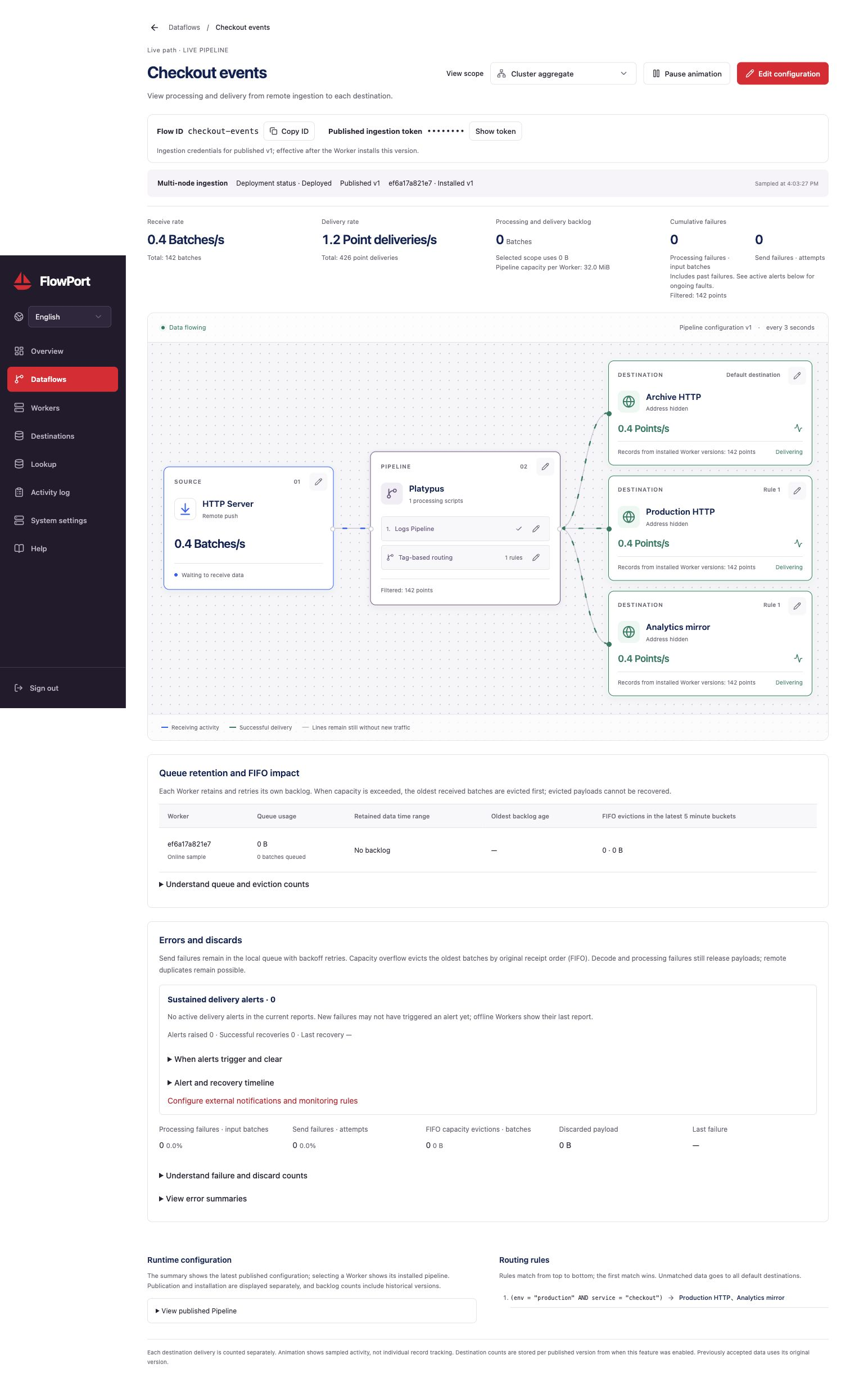
The runtime view separates deployment status from actual delivery. Cumulative processing failures and send failures each show a separate value and unit. Input batches and send attempts cannot be directly compared or subtracted.
The summary shows the latest published configuration; selecting a Worker shows its installed pipeline. Publication and installation are displayed separately, and backlog counts include historical versions.
Capacity monitoring
Monitor input and destination quotas, backlog and disk space. Quotas are logical; CPU, network, storage and disk are shared.
Monitor application RSS, cgroup anonymous memory and file cache, plus actual data-directory usage and log-segment counts. A logical quota is not a physical disk ceiling: checkpoints, active logs and compaction need headroom. Resource samples taken every 15 seconds can miss transient peaks and are not hard resource guarantees.
Routine maintenance triggers on new WAL bytes: twice the previous checkpoint size, bounded to 16–256 MiB. Disk-pressure recovery remains independent. Checkpoints advance only their captured byte watermark; concurrent appends count toward the next round. Segment-live statistics update incrementally, and old segments are reclaimed only after payload references and checkpoint protection are released.
Queue retention and FIFO impact
Recent evictions cover the current and previous four minute buckets and survive restarts. Queue times use original receipt times. Offline nodes show the last sample, which cannot predict current retention.
Evictions count local inputs or destination branches and cannot be converted into a unique-input loss rate. Destination copies and batch limits shorten retention. Logical quota does not reserve physical disk space.
The Workers page shows batch ceilings and available/total space on the data-directory filesystem. Space is shared with other filesystem users, not reserved for queues. Missing fields from older Workers remain unknown.
Processing and delivery backlog separates selected-scope usage from published per-Worker capacity; it does not compare cluster-wide usage with a single-node limit. Capacity changes take effect after Worker installation and remain subject to the node total quota. The queue table lists usage and queued batches per Worker. Queue eviction and failure counting details are collapsed until needed. Failed send attempts include retries and are not a count of lost inputs.
Diagnose delivery errors by code
0.1.21 preserves recognizable underlying causes as dns_error, tls_error, connection_refused, timeout, authentication_error, receipt_error or network_error. Unclassified causes use send_error. Remote error bodies, addresses and credentials are not stored. The runtime view provides guidance by category.
Use connection testing on this Worker to diagnose network, authentication and protocol issues. A connection test does not prove a successful write.
Referring flows and configuration rollout
Republish referring flows and wait for Worker installation. Backlog for the same destination ID retains its processed result and uses the new connection on subsequent retries. Old in-flight requests cannot be recalled; recovery may produce duplicates.
Compares saved destination settings; unsaved edits are excluded. Renaming does not require publication. Workers with the current connection installed use it on subsequent retries; old in-flight requests cannot be recalled.
Separate current status from cumulative history. Active delivery alerts identify sustained faults; processing failures and failed send attempts include history and do not reset after recovery. No active alert does not prove health: a new fault may not yet meet the threshold, and offline Workers retain their last report. Check destination configuration opens a destination still in the current route. After fixing its address or credentials, save, republish referring flows and confirm Worker installation; actual successful delivery confirms recovery.
Resource and history limits
Input processing has 8 separate slots. Delivery has 32 slots and at most 4 per explicit endpoint, falling back to destination ID. Each output lane sends at most 8 batches per 25ms turn, reserving 4 slots for newly active endpoints. Distinct endpoints can still wait; zero waiting is not guaranteed. Group durable admissions across flows and cursors. Batch UDP/TCP input, run queue maintenance in the background and prepare Lookup validation, indexes and files outside the queue lock. Senders use time slices, reserved endpoint capacity and a whole-batch batch_timeout_seconds deadline. HTTP upload slots are separate from decoding; Firehose requests have one durable admission boundary. Socket ingestion drains complete buffered frames after peer closure.
HTTP OTLP, Prometheus Remote Write and all gRPC listeners share 4–16 CPU-scaled process-wide push slots. gRPC reserves before reading a message, allows 4 concurrent streams per connection and bounds an RPC to 60 seconds. The decompressed wire limit remains 32 MiB. Structural checks run before decoding, followed by an 8 MiB conservative expansion estimate before Point conversion, including repeated resource/scope metadata. Vector expansion is also bounded. Busy input returns HTTP 503 or gRPC ResourceExhausted; HTTP structural/expansion limits return 413; gRPC expansion limits return ResourceExhausted, while the framework wraps pre-decode structural rejection as Internal without acknowledging receipt. Reduce upstream batch size, attributes or distributions before resending. These budgets are not equivalent payload-size or RSS limits.
Prometheus Remote Write also checks protobuf structure before decoding and applies an 8 MiB conservative estimate before Point conversion, accounting for samples, native histograms, exemplars and labels repeated per point. Over-budget requests return HTTP 413 without queue acceptance or acknowledgement. It shares 4–16 protocol push slots based on GOMAXPROCS with OTLP/Vector; busy input returns 503 with Retry-After. Reduce batch size or labels before resending. Queue retention, FIFO and delivery retries are unchanged.
Each Fluent frame and each Datadog trace MessagePack request is limited to 65,536 array/map containers and 262,144 values, including keys and containers themselves. All PackedForward entries share the whole frame budget, including after gzip decompression; the next frame starts a new count. Over-budget input is rejected before admission: Fluent closes that connection without a chunk ACK, while Datadog HTTP returns 413. Retry smaller batches or less nested content. Byte, individual-container and depth limits still apply; structure counts are not RSS limits.
Installation checks local files/listeners only. Cloud identity discovery runs with the Source in the background; failures remain visible and retry without blocking other flow leases. Each underlying AWS container-credential HTTP request has a 3-second timeout and no internal retry; normal business request timeouts remain separate.
History keeps the latest 100 versions per flow within a shared 64 MiB encrypted-snapshot budget. Oldest unreferenced history is collected. Active, normal/legacy queue, in-flight delivery and manager-approved/Worker-reported versions remain protected and can exceed the history count. New publication fails if protected snapshots fill the budget; existing intake/queues continue, and pre-upgrade excess references remain. Deleting a drained flow releases full snapshots while retaining its reserved identity. Previously assigned remote Workers collect retired configurations only after both local normal and legacy queues drain; offline Workers apply the notice after reconnecting. History/restore cover retained versions only. Checkpoints and normal log reclamation release physical space later. Legacy failed payloads are never silently deleted.
The current release uses control protocol v9 and checkpoint format 3, and reads formats 1/2. Stop services and back up every node’s complete data directory, master.key, Lookup resources and environment before coordinating the manager and all Worker upgrades. Downgrade requires the complete pre-upgrade backup and reconciliation of newly accepted data; never open or overwrite an upgraded directory with an old binary.
0.1.25: offline recovery and receiver backoff
These features are included in 0.1.25. Check collectway -help for maintenance, and verify/restore with the exact release version recorded in the backup.
Stop the instance and reset the password as the original data-directory owner, using the instance root as data-dir. Live directories, missing managers and uninitialized paths are rejected. Use an owner-only regular password file (0600), or a protected pipe with reset-password-file -; plain terminal input is refused. Passwords require at least 12 characters and at most 72 UTF-8 bytes; spaces are preserved. Only the existing manager password hash changes, with a durable local audit record. Other credentials and queues remain intact; restarting invalidates old browser sessions.
Stop the instance before backing up its manager and local Worker; back up remote Workers separately. The output must not exist and must be outside the source, with an existing parent. backup-env is optional; omitted environment files are not collected automatically. The manifest records version, store layout, lengths and SHA-256. A temporary copy validates journals, checkpoints and retained payloads. Corruption, wrong keys, symlinks and escaping paths are rejected. Files are 0600 and directories 0700; keys and possibly credential-bearing env files are included. Creation needs the backup plus one validation copy; verification needs one temporary copy. Hashes do not authenticate untrusted backups.
Restore only into a new directory, preserving identities, configuration, queues, counters and cursors. Legacy isolated failures still require explicit handling. Environment files are not installed over /etc; restore them manually from the backup when needed. Return ownership to the service user and configure the new data-dir before starting. Never run both copies of the same identity. Check login, queues, Worker versions and actual receipts; reconcile data accepted or sent after an older backup.
Default backoff remains capped at one minute. Generic HTTP and Dataway Retry-After (seconds or HTTP date), and gRPC RetryInfo, can extend the failed batch minimum delay beyond one minute and survive restart; invalid, negative or elapsed values add no delay. This is per-batch scheduling, not global target rate limiting. Intake, healthy branches and original-receive-order FIFO continue; delayed items receive no capacity protection.
collectway -data-dir /var/lib/flowport -maintenance reset-password -reset-password-file /run/flowport-password
collectway -data-dir /var/lib/flowport -maintenance backup -backup-path /srv/backups/flowport -backup-env /etc/flowport/flowport.env
collectway -maintenance verify-backup -backup-path /srv/backups/flowport
collectway -maintenance restore -backup-path /srv/backups/flowport -data-dir /var/lib/flowport-restored
0.2.1: Kafka historical data and send deadlines
Fix Kafka delivery expiry incorrectly measured from event time against a fixed 20-second limit. Historical logs, metrics, traces and other Point categories no longer fail before transmission because of their age. Preserve both the Kafka message timestamp and original event timestamps in encoded payloads. This covers all Kafka outputs and service presets using the Kafka protocol.
Each Kafka send attempt uses config.timeout_seconds, default 20 seconds and range 1–120 seconds, while honoring an earlier parent cancellation or deadline. A retry starts a new send deadline. Failed delivery retains the original queue and processed output; recovery does not rewrite event times or clear backlog.
0.2.1 retains control protocol v6 and checkpoint format 3. Stop services and back up complete data directories, master.key, Lookup resources and environment configuration before upgrading the manager and all Workers. Retained Kafka backlog retries automatically from the existing data directory; FIFO-evicted data cannot be recovered. Broker and cloud-service timestamp limits and retention policies still apply.
0.2.2 integration reliability
Dataway, GCP Monitoring, Azure Monitor Logs and Snowflake require a complete HTTP response with a maximum body of 1 MiB. Truncation, read timeout or oversized responses report receipt_error and retain the queue. Generic HTTP, telemetry, Bulk and Stream Load recheck cancellation and deadlines after EOF. Retries preserve prepared results; remote acceptance followed by a lost response can cause duplicates. Capacity and FIFO rules remain unchanged.
Redis, MQTT, NATS, Pulsar and RocketMQ destination timeouts use config.timeout_seconds. Fix cancellation of blocked Socket/Syslog, NATS and Redis writes. MySQL no longer has a fixed 20-second read/write cap; SQL Server preserves URL dial timeout, and MongoDB sources preserve serverSelectionTimeoutMS. Prometheus uses scrape_timeout_seconds. SLS/OSS retain both request and owning-operation cancellation. Pulsar synchronous initialization still has SDK cancellation limits and is not a strict total deadline.
Google Cloud Storage, Cloud Logging, Monitoring, BigQuery and audit token refresh follow the current request context. Concurrent refresh waiters can cancel at their own deadlines; failed refresh can retry and successful tokens remain cached. Microsoft 365, Entra and Google Workspace audit refresh is corrected, preserving the Workspace delegated user.
SQS, S3 + SQS, CloudTrail and GuardDuty receive one message at a time and renew the active message, preventing unprocessed prefetched messages from expiring while waiting. This increases ReceiveMessage calls; long polling remains enabled. Beats starts its ACK write budget after durable acceptance, so backpressure does not consume that budget. Rejected input is not acknowledged.
RocketMQ route and broker connections use each flow’s TLS and connection options. Initialization honors the current request deadline and source shutdown. Successfully initialized destinations remain reusable, and broker-supplied policies cannot enable extra send retries.
0.2.2 retains control protocol v6 and checkpoint format 3. Stop services and back up each node’s complete data directory, master.key, Lookup resources and environment before upgrading the manager and every Worker. Restore the original data directory; installation and runtime require no Node.js. Cloud permissions, retention policies and protocol acknowledgment capabilities remain deployment-specific.
0.2.3 concurrency and draining
Fix accepted Lookup resources being lost during concurrent first creation. Historical version collection rechecks the latest catalog and preserves versions and files successfully uploaded or reactivated during collection. Queued batches keep the data versions pinned at acceptance.
Worker draining, flow deletion and monitoring check in-memory windows, in-flight processing and durable queues together. A final window that cannot enter the queue is retained and blocks drain confirmation and deletion. Process shutdown no longer counts as an online drain confirmation. Caches and windows remain bounded in-memory state and clear on restart; drain online before stopping to preserve final windows.
Fix diagnostic updates missed during checkpoint maintenance or graceful shutdown. Persisting diagnostic counters does not change business queues, delivery results or failed-payload protection.
Kafka, Debezium and Avro OCF check each record before decoding allocations, with a structural budget of 32 MiB and nesting depth of 64, preventing compact encodings from expanding into excessive objects. The budget includes containers and JSON escaping and is not a process memory limit. Preserve Confluent top-level raw bytes compatibility; OCF budgets reset for every record.
0.2.3 retains control protocol v6 and checkpoint format 3. Stop services and back up each node’s complete data directory, master.key, Lookup resources and environment before upgrading the manager and every Worker together. Restore the original data directory; downgrade using the complete pre-upgrade backup. Installation and runtime require no Node.js.
0.2.4 resource bounds and recovery
Fix cursor advancement during chunked historical object handoff, oversized cursor metadata blocking queue admission, tight retries on corrupt payloads and delayed idle Lookup cache reclamation. Preserve the Lookup data versions pinned by queued batches and FIFO by original receipt order.
Check structure or expansion budgets before parsing and converting JSON, DataKit, Datadog, Prometheus, Parquet and Delta metadata, including amplification from shared labels, service discovery, relabel rules, dictionary references and flattened paths. HTTP pagination also checks fields that will not be emitted. Reject the affected request or target when over budget; reduce batches or structures to recover. Exact limits are documented in Source, continuous collection and extended integrations; budgets are not process RSS limits.
Chunk SQL query admission by bytes and structural budget, reduce conversion costs for PostgreSQL JSON/JSONB and large Oracle transactions, and make MySQL CDC connection, snapshot and shutdown respond to cancellation. Redis Streams acknowledges upstream-deleted messages only after recording their loss. GCS notification downloads share four slots held through durable acceptance.
Datadog series v1 and Sketch reuse shared tags within each series, reducing repeated construction for normal multisample batches while preserving each sample’s value and time. Datadog HTTP joins the existing four protocol input slots: busy requests receive 503 with Retry-After; decoding or expansion budget violations receive 413 without queuing or acknowledging any part of the batch.
0.2.4 retains control protocol v6 and checkpoint format 3. Stop services and back up every node’s complete data directory, master.key, Lookup resources and environment before upgrading the manager and all Workers together. Restore the original data directory; downgrade using the complete pre-upgrade backup. Installation and runtime require no Node.js. Real cloud permissions, upstream versions and sustained load still require deployment-specific validation.
0.2.5 concurrency and resource lifecycle
Narrow Store and Pipeline state lock scopes so metadata reads, payload reads and independent state scopes can proceed during disk commits. Waiting ordinary admissions for the same flow can share a durable commit, and full queues select FIFO eviction candidates with a heap, reducing contention and backpressure overhead. Acknowledgement still follows write and fsync; original receipt-order FIFO, at-least-once delivery and ordering within each state scope are preserved.
Remove empty completed cursor receipt lists immediately. Reclaim source-generated historical cursor keys only when restorable configurations and in-flight references no longer need them, preserving progress required by drafts, retained revisions, queues and Workers. Normal maintenance releases Lookup caches idle for over five minutes without active sessions; immutable version files and versions pinned at intake remain unchanged.
TCP frames for socket, syslog, statsd and fluent have a default 300-second read deadline, configurable from 1 to 3600 seconds with read_timeout_seconds. Fragment bytes do not extend it; active multi-frame connections remain reusable. Messaging Senders load TLS configuration at creation; rebuild or republish a Sender after certificate rotation. Ordinary Protobuf and legacy points JSON decoding enforce a 10000-point budget, while normalized source batches use bounded chunks and retain whole-batch validation atomicity.
0.2.5 retains control protocol v6 and checkpoint format 3, adding optional journal deletion fields. Stop services and back up every node's complete data directory, master.key, Lookup resources and environment before upgrading the manager and all Workers together. Downgrade using the complete pre-upgrade backup. In-memory windows and deduplication state still clear on restart; drain online before stopping to preserve final windows. Installation and runtime require no Node.js.
0.2.6 receipts and recovery
Fix successful concurrent ingestion receipts whose full merged group was not written to the journal; fall back to individual durable admission when capacity is insufficient. Bound grouping at native Kafka, AMQP, JetStream and Redis Streams read boundaries, retaining per-record tags and acknowledging only the durable prefix. Persist malformed-record counts before skipping; retry dependency and queue failures. Validate the 10000-record and structural budgets before HTTP success, and add bounded deflate/zstd decoding.
Atomically retain unconfirmed ES/OpenSearch Bulk documents; acknowledge create 409 only after GET confirms identical complete content. Apply per-record send deadlines to SQS, MQTT, JetStream and Pulsar, persist the confirmed prefix and retry only remaining records. Cap receiver delays at one hour and correct old excessive deadlines on recovery. Require credentials again when an address changes. A lost receipt after remote acceptance can still cause duplicates.
Update cursor receipts through local links and separate immutable cursor values, preserving FIFO, out-of-order confirmation and legacy-array migration. Persist changed cluster nodes, tasks and commands atomically; retain versions referenced by node patches. Use monotonic lease and instance-liveness clocks. Reclaim idle windows and emitted aggregate groups, copy aggregate candidates on demand and reduce compilation and destination-cache contention.
Cache Delta Lake snapshots, read incremental logs and write complete classic checkpoints at geometric intervals to limit write amplification. Reuse Iceberg Catalog while refreshing each table per batch. Advance filtered PostgreSQL WAL progress, throttle empty MySQL progress and bound Oracle committed SCN windows while retaining the long-transaction floor. Keep connection deadlines and caller cancellation for object downloads; durably count malformed lines/gzip and improve Socket, NetFlow and Prometheus recovery.
Control protocol v6 and checkpoint format 3 remain, but older binaries cannot safely take over the new cursor and cluster layouts. Stop services and fully back up every node data directory, master.key, Lookup files and environment before upgrading the manager and all Workers together; restore the complete pre-upgrade backup to roll back. Node.js is unnecessary at runtime. Existing regressions cover real PG/MySQL/Redis/NATS/RabbitMQ; native Oracle, Kafka brokers, ES/OpenSearch, complete Iceberg/MinIO deployments and long-running workloads still require environment qualification.
Execution budget and SQL Server cancellation
Fix persistent Pipeline budget failures blocking FIFO intake, orphaned collectors after concurrent starts, and a nil dereference during split acknowledgements. Each input batch gets at most three attempts: the first two budget failures wait 1 and 2 seconds; a third failure releases the whole input batch as pipeline_error. The count survives restart. Worker shared state bytes or scope exhaustion retain input for retry; an individual scope exceeding 8 MiB still releases failed input.
SQL Server handshakes, queries and transaction confirmations obey caller cancellation and deadlines. Close the connection if cancellation acknowledgement is missing, then reconnect for retries. URL connection timeouts and valid long queries are preserved.
0.4.0: private HTTP read protection and administrator controls
0.4 upgrade: private HTTP reads are denied by default. Existing Prometheus, Kubernetes, Consul, HTTP Client, Schema Registry and Lookup collection may pause; data and cursors are retained. Configure required CIDRs for the manager and each executing Worker.
Administrators can save allowed CIDRs per node in Settings → Network reads without restarting. The manager and local Worker share a policy; remote Workers persist their own. API Keys, Flows and MCP cannot change it. Explicit startup flags or nonempty environment variables take precedence and make the UI read-only. An empty environment variable allows UI configuration; an explicit empty flag locks the default deny policy. Only subsequent requests use updates; in-flight requests finish normally.
Fix AMQP cleanup accumulation during repeated reconnects and classify encoding failures consistently, retaining unconfirmed records. Includes the earlier main-only read egress, trusted proxy, ingest /metrics removal, GCP stop, AMQP/Pub/Sub partial receipt and WAL commit boundary fixes. Lost network acknowledgments can still cause duplicates.
Linux amd64/arm64 deb, rpm and tar.gz packages use Go 1.27.3. Stop services and back up complete data directories, master.key and env before upgrading. Install scripts preserve existing env files and never allow private access automatically. Preconfigure FLOWPORT_READ_EGRESS_ALLOW_CIDRS on every node or use the UI after upgrading; affected collection pauses with data and cursors retained until allowed. Upgrade all relevant managers and Workers for full protection; protocol remains v6. Downgrades require the complete pre-upgrade backup.
0.4.1: read security fixes and throughput improvements
Fix a data race between live read-policy updates and HTTP timeout cancellation. API-provided GCP X.509 configuration cannot replace the restricted read client, including nested identity credentials. API credentials cannot use the node executable-identity opt-in to start commands. Node-owned SDK identity chains remain supported.
Push ingestion uses 4–16 slots based on GOMAXPROCS; Prometheus pulls have a separate pool of 2–8 slots. Bound and batch message input, and group durable Transform, retry and release commits. Incremental FIFO and segment-live accounting, version caching, WAL-byte maintenance triggers and in-memory online telemetry reduce backlog and multi-flow overhead. Retired nodes retain durable final counters and drain evidence.
SQL append writes multiple rows within one transaction. Elasticsearch uses compact bulk receipts and batched conflict readback. SQS sends batches; MQTT, Pulsar, JetStream and RocketMQ use bounded asynchronous windows and release only explicitly confirmed records. Redis list disables SDK replay of acknowledgement commands so lost responses cannot repeat removal. Group Loki streams by labels, reuse AWS identity configuration and HTTP pools, and use 256 KiB Firehose spool frames.
0.4.1 retains control protocol v6, checkpoint format 3 and default denial of private HTTP reads. Node CIDRs saved in 0.4.0, startup flags and environment configuration remain effective. Stop services and back up each node’s complete data directory, master.key, Lookup resources and env before upgrading the manager and all Workers. Private collection on older versions needs required CIDRs before upgrading or administrator approval per node afterward. Move executable identity configuration from API credentials to administrator-controlled node configuration. Downgrade using the complete pre-upgrade backup.
Linux amd64/arm64 deb, rpm and tar.gz packages use Go 1.27.3. Validation includes OrbStack race regressions, local MySQL, Redis, RabbitMQ and JetStream services, and policy changes on separate manager/Worker processes. GCP Monitoring retains up to eight concurrent individual point receipts because partial batch summaries cannot reliably identify accepted records. Local benchmarks are not production throughput guarantees; Transform is not guaranteed faster on fast disks. Real cloud accounts, uncovered services and production-duration load require deployment-specific validation. Lost network acknowledgements can still cause duplicates.
Queue scheduling and intake
A timer output can release the destination capacity an earlier ordered input needs. TCP and Syslog commit complete records before waiting for the rest of a partial frame. Lookup builds cold indexes outside the store write lock, and standalone destination usage counts queued batches for retired destinations until they drain.
Socket Pipeline updates and TCP backpressure
Existing TCP and UDP Socket listeners stay active when their Source settings are unchanged. After the Worker installs a Pipeline update, newly admitted records use the new version, even on an existing TCP connection. Queued batches keep their original version.
When the input queue is full, TCP Socket, Syslog and StatsD close the affected connection and count decoded records refused before durable admission. See the rejection reason in the runtime view, source_rejected_records in the API and collectway_flow_source_rejected_records_total in Prometheus. Accepted backlog stays queued.
A write-and-close sender can exit before the reset and still see zero socket errors. After the backlog drains, compare the sender's records with the records in Kafka and the change in source_rejected_records for the same flow, Worker, and time window.
Backpressure, cursor and delivery recovery
Intake diagnostics distinguish rejected records from decode drops. Kafka, object notifications, paginated audit sources and Kubernetes listing preserve or validate progress when resuming.
Delivery keeps valid partial receipts and retries unconfirmed records. Writes without a protocol receipt are counted as sent_without_receipt.
Supported destinations persist Retry-After alongside local backoff. Queue-head diagnostics show the effective retry time.
Intake and recovery in 0.5.11
Beats commits compressed windows in groups and sends one cumulative acknowledgment for the durable prefix. Beats and Fluent release shared decoding slots before waiting on disk or writing acknowledgments.
Datadog Logs validates JSON and batch limits before issuing a receipt. Invalid input returns HTTP 400, oversized input returns HTTP 413, and a full queue returns HTTP 503 for retry.
CDC snapshots, SLS, search and Kinesis use bounded batches and preserve durable progress when resuming. CloudWatch Logs stores deduplication cursors as compressed blocks.
NATS Core saves buffered records it has already read when the connection closes. MQTT, Pulsar and Pub/Sub recheck Worker admission before acknowledging. Cluster handoff uses the latest durable cursor reported by the prior owner.
Metrics, TLS and Lookup in 0.5.12
MongoDB retains wide serverStatus results in points with the same sampling timestamp and one batch. Nested BSON uses the driver’s default decoder.
PostgreSQL keeps TLS enabled on fallback hosts and preserves ALPN in direct TLS mode. MongoDB retains URI trust roots and client certificates unless explicitly replaced.
Azure Blob and Service Bus verify their own endpoints. Pulsar reloads the private CA on new connections and reloads the client certificate and key when a TLS server name is specified.
The manager allows up to two Lookup downloads totaling at most 128 MiB. Downloads reclaim idle cache under memory pressure. Manager transfers and Worker downloads return HTTP 503 with Retry-After when capacity is temporarily unavailable.