
Expand Workers. Keep activation offline.
Separate management, scheduling and local delivery responsibilities.
The website brand is now FlowPorts. These screenshots were captured on 2026-10-26 from the released 0.4.1 English interface, which still displays the original FlowPort name, in an isolated OrbStack instance with synthetic data. See the integration guide for the MaxCompute destination introduced in 0.5.13. Addresses and counters are examples; CDC and Dataway forms illustrate configuration without connecting to real services. Select an image for full size. The screenshot manifest records build provenance and file hashes.
Start with Community
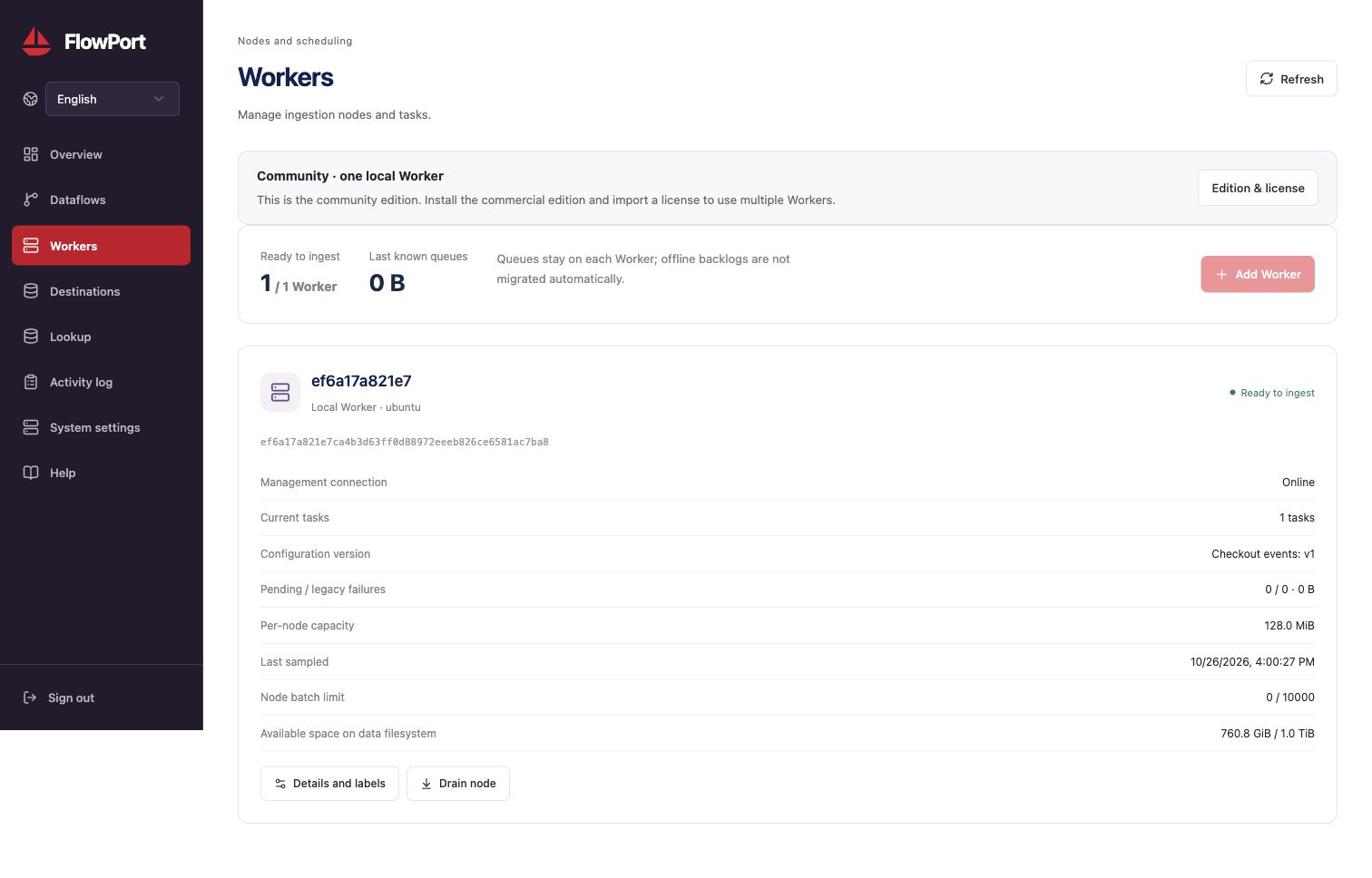
Community supports one local Worker with no dataflow-count limit. Existing collection, processing, routing and management capabilities remain available. Remote registration and task assignment require a commercial license.
Offline activation
The public Community packages do not include commercial verification roots. Importing a license alone cannot enable multiple Workers. First obtain an issuer build with trusted keys matching the license series; supported formats appear on the license page.
Copy the cluster ID from System settings → Edition and license and ask the issuer for a cluster-bound LicRegister offline file. Import and preview it, review validity, Worker quota and affected nodes, then activate.
Activation does not contact a remote server. Releases pin trusted public keys. A license does not replace Source tokens, node authentication, TLS or the administrator password.
Join and schedule
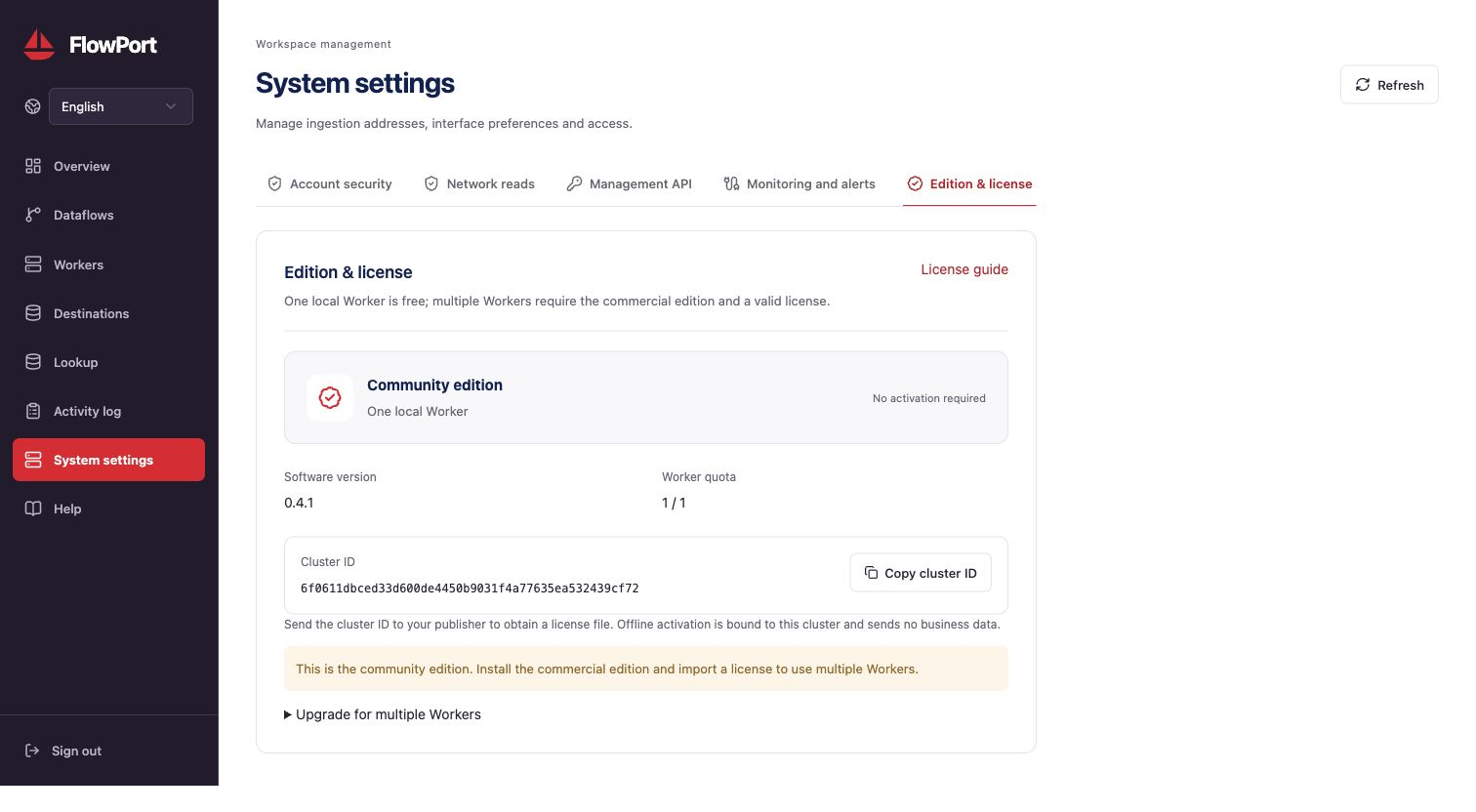
With a valid license, generate a join credential in Workers and deploy nodes. Quota includes local, offline and draining nodes. Stopping a container does not release a slot; drain and remove it.
Push, shared messaging and exclusive polling have different placement rules. Takeover follows leases and stop confirmation; it is not a promise of uninterrupted ingestion. Old backlog stays on its original Worker.
Recovery snapshots require the manager’s persisted assignment history for that flow and an installed version no higher than the approved version. A Worker’s Installed claim alone does not authorize credential access. This boundary survives manager restart; previously approved backlog Workers can still recover.
Valid unchanged tasks renew before new tasks are prepared. New Source listener preflights share one 3-second timeout per plan and rotate through pending tasks, so blocked DNS cannot consume one timeout per flow or starve later assignments. Tasks not yet attempted continue in later syncs; reported preparation failures still require revalidation or a corrected publication. DNS resolution for preflight and running TCP, UDP and gRPC listeners honors context cancellation. A shared Source continues during manager outages; an expired exclusive epoch cannot be revived by late renewal.
Expiry and runtime boundaries
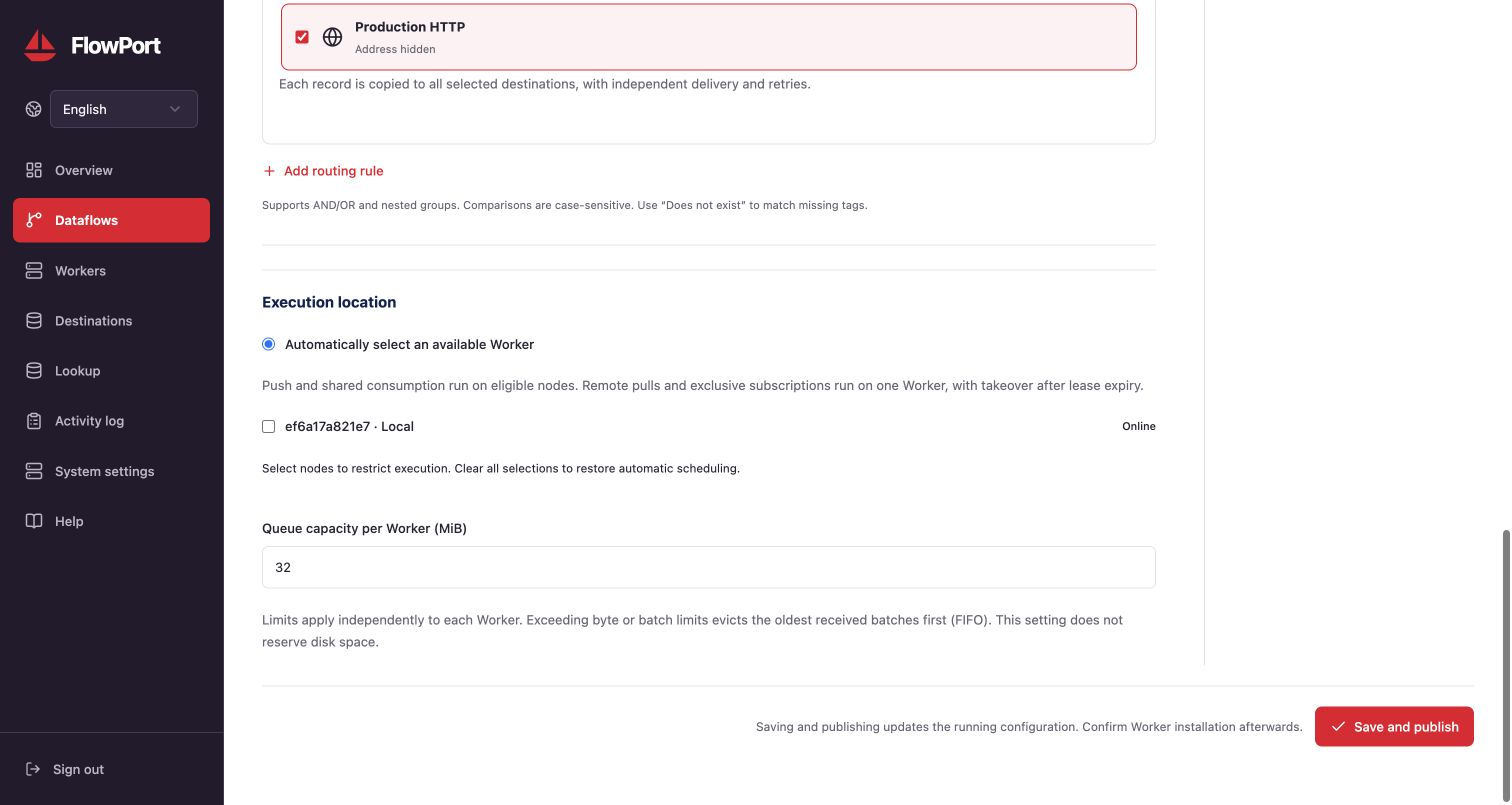
Each Worker retains its own queues. Previously approved nonexclusive intake continues during manager outages while capacity allows; exclusive tasks still require ownership leases. Full queues apply backpressure.
Use matching manager and Worker releases and reliable server time. Offline signatures and validity depend on the server clock.
Local queues and isolated alerts
Each Worker retains its own queues. Previously approved nonexclusive intake continues during manager outages while capacity allows; exclusive tasks still require ownership leases. Full queues apply backpressure.
Sustained delivery alerts are isolated by Worker, flow and target. Success on another node or a healthy target cannot clear the failed target alert. FIFO eviction and republishing are not recovery. Republishing the same target ID retries retained processing results using the new connection configuration; subsequent attempts switch after a node receives and installs the new version. Before synchronization, cached connections may still send, and already-started old requests cannot be recalled. Verify recovery with fresh per-node reports and actual successful sends.
Edition & license
This community build cannot activate cluster licensing directly. Obtain the matching commercial build before importing a License.
Provide the cluster ID to obtain a commercial build with the matching verification key and a license file.
Schedule maintenance, stop the manager and each Worker, and separately back up each complete data directory with master.key.
Preserve data directories, keys and node identities while upgrading all nodes to the same release. Never run two instances against the same directory.
Start the manager, validate and activate the license, then start Workers and verify version synchronization, queues and actual deliveries.
Manager outages and offline restart
Each Worker retains its own queues. Previously approved nonexclusive intake continues during manager outages while capacity allows; exclusive tasks still require ownership leases. Full queues apply backpressure.
Exclusive tasks still renew every 5 seconds with a 30-second ownership lease, independent of the license expiry time. They stop requests and connections when that lease expires during an outage and recheck admission before enqueueing. Takeover without explicit stop confirmation waits for expiry plus a 5-second guard. Late renewal cannot revive an expired epoch. Manager restart waits out the complete former ownership window. Healthy owners do not rebalance on each heartbeat. Failures may cause sampling gaps or short-lived duplicates; exactly-once delivery is not guaranteed.
On restart, a Worker first attempts manager sync. Only temporary unavailability allows recovery from durable approval bound to the current Worker identity, credential and manager, using matching local non-exclusive snapshots. Installed configurations or backlog connections alone do not authorize new intake. New, unassigned, stopped, drained or revoked tasks and exclusive tasks cannot start offline on their own. Older installations need one successful sync to obtain approval. Stop, removal, configuration and license decisions cannot reach an isolated Worker immediately and apply after reconnecting; detach upstream/LB traffic or stop that Worker for emergency isolation. Never run cloned identity directories concurrently.
The current release uses control protocol v9 and checkpoint format 3. Back up and coordinate upgrades of the manager and all Workers. Read protection requires every relevant node to be upgraded and its required CIDRs configured.
Historical note: 0.1.27
0.1.27 keeps approved non-exclusive inputs and shared consumers running during manager outages, with identity-bound approval for offline restart. Commercial licensing is evaluated when communication returns. Exclusive tasks retain 30-second ownership leases; explicit identity or protocol rejection stops new input while accepted queues keep delivering. Back up and upgrade the manager and every Worker together to control protocol v5; upgraded nodes need one successful synchronization before offline restart is available.
Reduce allocations for unchanged approvals, reuse connections on temporary synchronization failures, and avoid repeating failed preparation for the same version. Revalidation or a new publication resumes preparation. Running-source reconnects, continuous intake, independent local queues, FIFO, target retries and alerts retain their existing contracts.
Coordinated upgrade and recovery
Lookup in 0.4.1 uses control protocol v6 and checkpoint format 3. Upgrade the manager and all Workers together. Stop services and back up complete data directories, master.key and environment configuration beforehand, including immutable Lookup resource files. Flow export is not a substitute. Older programs reject unknown resource references; downgrade requires the complete pre-upgrade backup. Bounded in-memory cache and window state do not survive restart.
Keep capacity reservations during temporary health failures, license restrictions and draining. Release only after explicit placement removal or an exclusive handoff, once queued, in-flight and window work ends. Cached connection updates cannot reacquire an empty flow’s released reservation; existing backlog still receives connection updates.
Lease fencing and handoff
The Manager commits lease and approval changes before publishing them. Authentication and committed control state remain available during writes.
Late heartbeats cannot renew expired leases. Drain confirmation waits for collectors to exit, and a graceful handoff uses the last reported delivered cursor.